
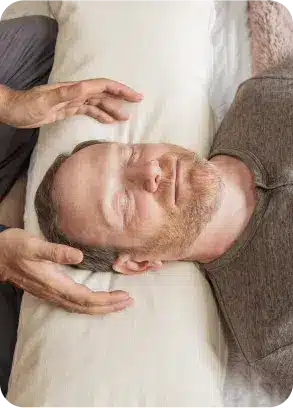
A stuck emotional pattern is one of the most common reasons people walk into our studio for the first time. It will not budge with journaling or willpower alone, but you feel it every time your body tenses up. Reiki meets you where talk therapy and self-help sometimes leave off, by working with the body directly rather than only the mind.
How reiki helps with stuck emotion
During a session, a practitioner places their hands on or near your body. This helps your muscles soften, your breathing slow, and your nervous system shift out of fight-or-flight and into rest. When the body settles at that level, stored tension often starts to move, and the feelings tied to that tension can come with it. Clients report feeling lighter, calmer, and clearer afterward. Some experience tears, tingling, or warmth. All of that is a normal sign of release, not a problem to manage.
This is a complementary practice. It does not replace therapy or medical care, and it is not a substitute for either. What it does is address the physical and energetic layer where feelings sometimes get stored, in a way that talk alone does not always reach.
How emotion gets stuck in the body in the first place
When you go through stress or a painful experience, your body shifts into fight-or-flight: heart rate up, muscles tight, breathing shallow. If that activation never fully discharges, the tension can settle into your tissues as chronic holding. Many people carry weight from old relationships, work burnout, or grief this way, often in the same few places: the neck, jaw, shoulders, chest, and gut. Talk therapy helps you make sense of what happened, and that matters. But the body sometimes holds on to what the mind has already worked through.
You might be carrying stuck emotion if you notice: exhaustion you cannot explain, a habit of absorbing other people's stress, a mind that will not turn off at night, or a body that stays tense even when nothing specific is wrong.
Why you might cry, and why that is a good sign
Crying during a reiki session is common and completely normal. As your nervous system settles into rest, stored tension surfaces, and tears are often part of that process. It is not weakness and it is not "being emotional." It is stress finally having somewhere to go. Some people cry. Some laugh. Some fall asleep on the table. There is no single right way to experience it.
"I left feeling deeply relaxed, like my energy was made of champagne bubbles, which felt both good and surprising considering I came into the session feeling stressed and upset."
Misty S., client
Another client described it this way after a session that focused on breathwork and grounding: "I was amazed to feel like I was able to take deeper breaths after going through this process. My lungs felt more open and cleaner, even though I hadn't been sick or anything like that."
What clients tend to feel afterward
Based on what we see most often, the shift usually shows up in one of four ways: a level of calm the body rarely reaches on its own, a real drop in day-to-day stress and anxiety, a physical lightness as held tension moves and clears, or a quieter mind that makes decisions feel simpler. Some people feel this on the table. Others notice it in the following day or two: better sleep, calmer reactions, a sense of feeling more like themselves.
It is also normal to feel mild fatigue or have vivid dreams in the day or two after a session. That is a sign your system is still processing, not a sign anything went wrong. We talk you through what to expect before you leave, and you can always reach us by phone or text if something comes up afterward.
What an emotional-release session actually involves
We start with a short conversation about what you are carrying and what you are hoping for, so there are no surprises. You stay fully clothed and lie on a treatment table while your practitioner works with hands on or near your body. Sessions can also include breathwork to help settle your system before the hands-on portion begins. There is no chanting and nobody will diagnose anything. It is quiet, skilled, and unhurried work, built around whatever you need that day.
Is this the right fit for you?
This approach tends to work well for people who feel emotionally stuck despite therapy or journaling, who carry chronic tension in the body, or who describe themselves as empaths or highly sensitive. It is not a single-visit cure, and it is not a substitute for crisis-level mental health support. If you are dealing with a diagnosed condition, please see your doctor first; reiki is meant to complement that care, not replace it.
Most people notice something shift after one visit, and the effect tends to build with a few more. If you are curious whether this fits what you are working through, the honest way to find out is to book a session and see how your own body responds.